The first six Enviro 400Hs were ordered on 14th April 2010 following the company's successful submission to the Government's Green Bus Fund competition held during 2009. Each bus cost a total of £300,000 of which £108,000 (the additional cost of being a hybrid) came from the government. The funding bid also included provision for a further 14 similar vehicles in 2011 if the first 6 prove successful. Further funding was obtained in the second round of the Green Bus Fund competition to provide a 11 more vehicles which were ordered along with the 14 remaining from the first round as a batch of 25, making a total of 31.
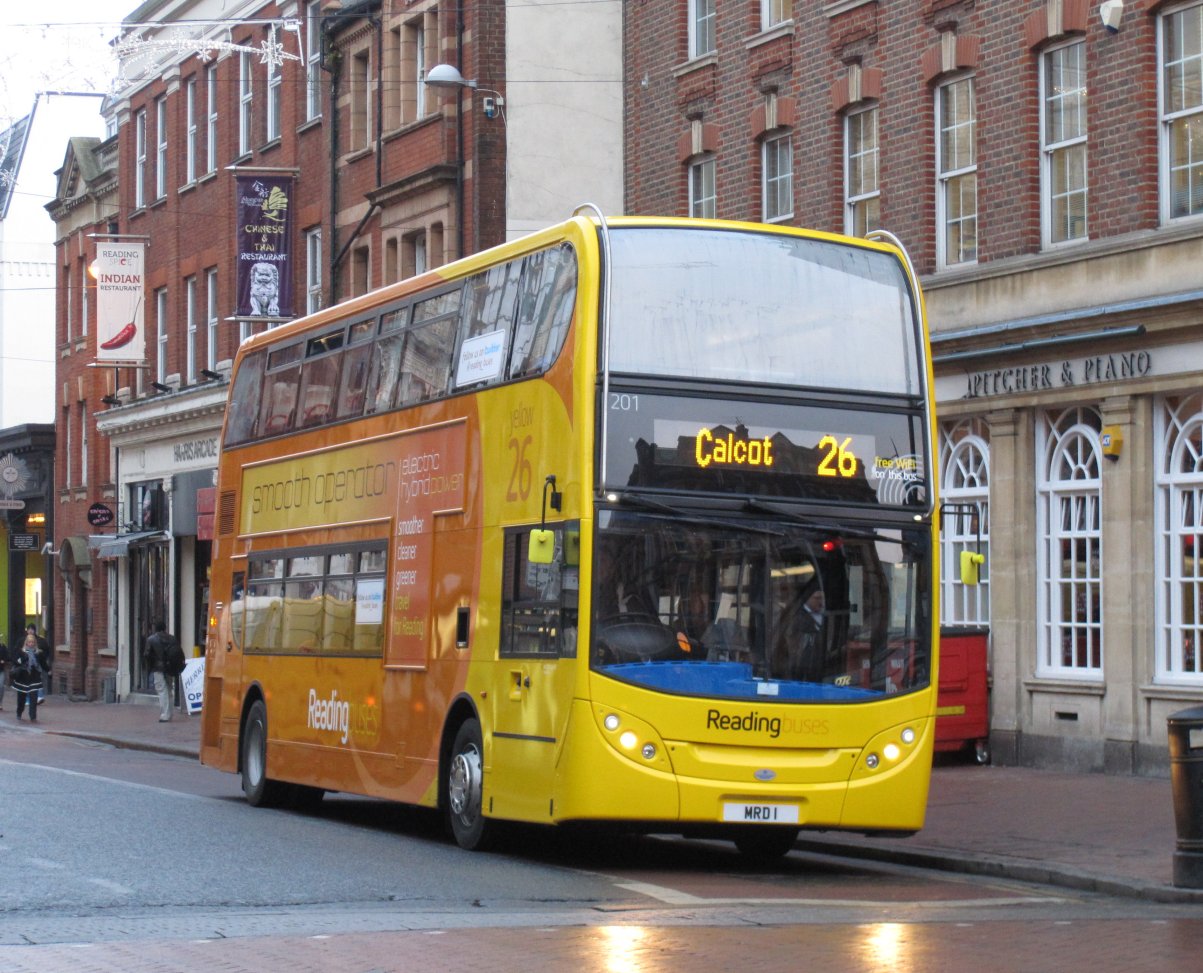
The buses are to a special extended length of 11.4 metres to give more legroom as well as more space on the lower deck for buggies and wheelchairs. They are also fitted with free WiFi. The first to arrive in Reading was 202 on 26th November 2010, featuring at a launch at the Old Town Hall on 6th December 2010 (see here). All six then entered service in yellow and orange route 26 livery on 13th December. 201 is seen below on 13th December 2010:
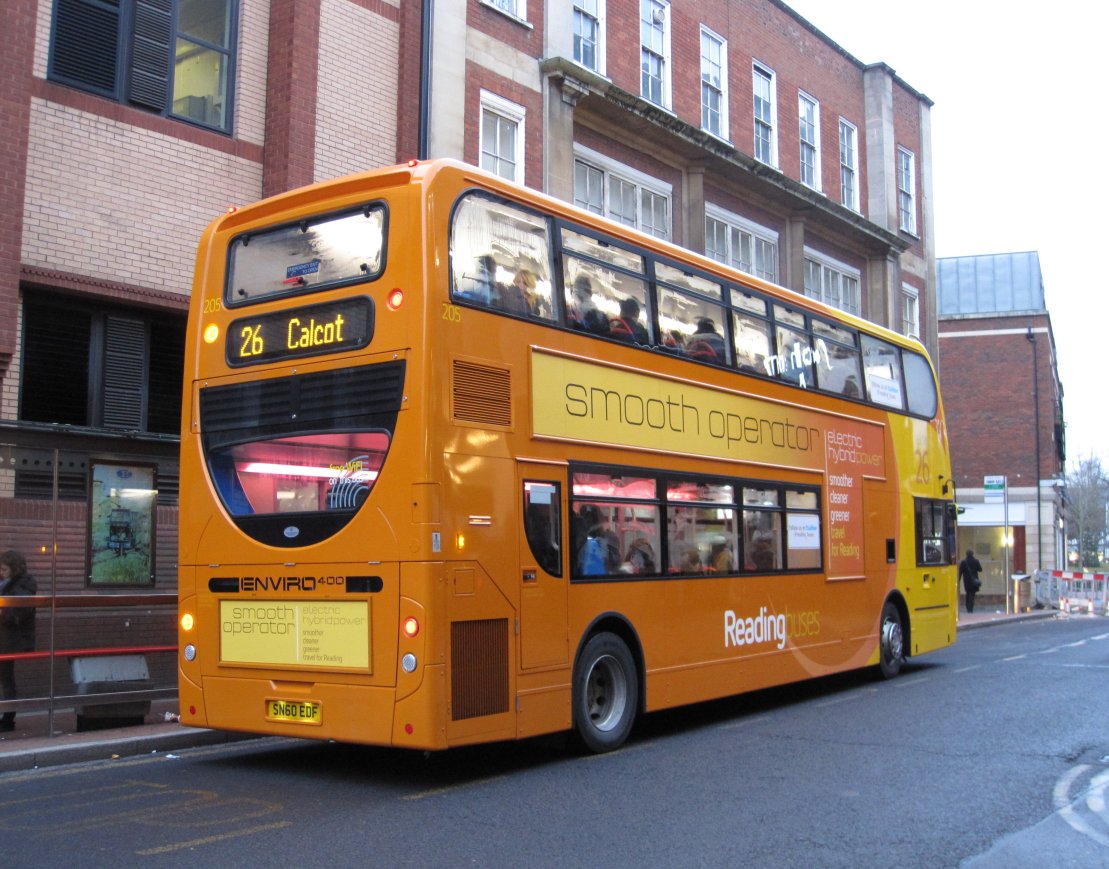
The rear profile of 205 on 13th December 2010:
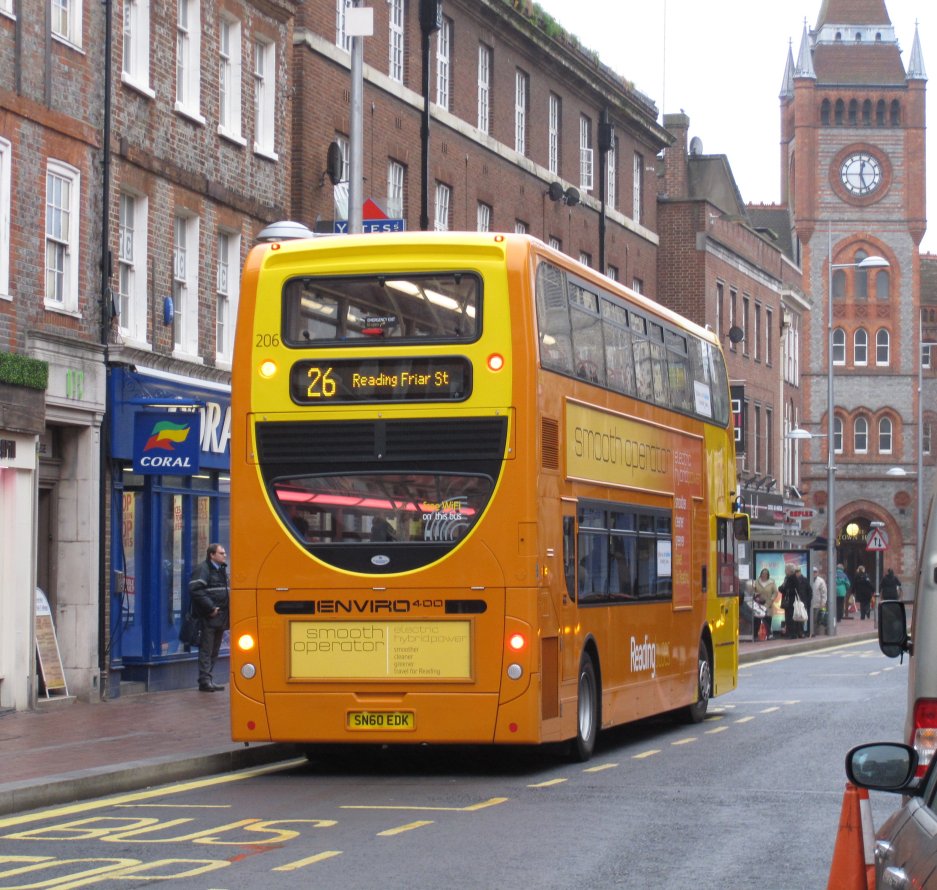
Due to delays caused by snow in December 2010, the final parts of the rear and interior route branding weren't fitted until 9th and 16th January 2011. 206 is seen below displaying the completed rear treatment on 7th February 2011:
Arrivals of the second batch commenced with 210-12 sometime between 27th and 29th June 2011 and 207/13 by 2nd July. After a short gap 216 followed on approx 25th July after being seen at the Leyland staging post on 23rd with 214/7/8 following soon after. 208 was seen at the factory in Falkirk on 28th July and arrived on 2nd August, and 209 arrived on 3rd August. 220 was seen at the factory in Falkirk on 30th August 2011, and 219-21 the Leyland staging post on 4th September pending delivery the following day. 222 arrived on 6th September, 223 on 7th, 224 on 8th, 225 by 11th, 226 by 11th, 227 on 12th (after being noted at Leyland on 11th), 228 on 21st, 229 on 21st, 230 on 23rd and 231 on 27th.
Initial liveries were as follows:
201-7 - Yellow 26
208-9 - silver and grey for use on any route
210-18 - Claret Routes for routes 20/20A/21
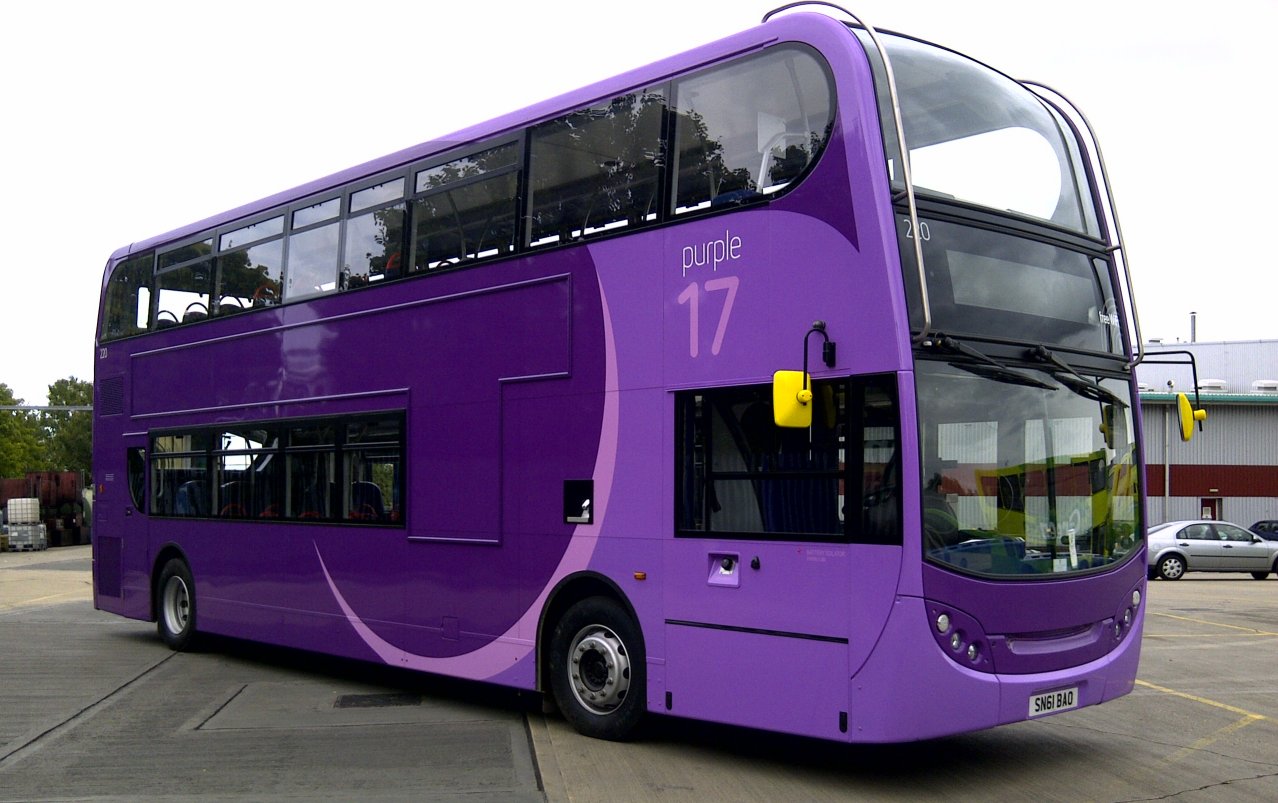
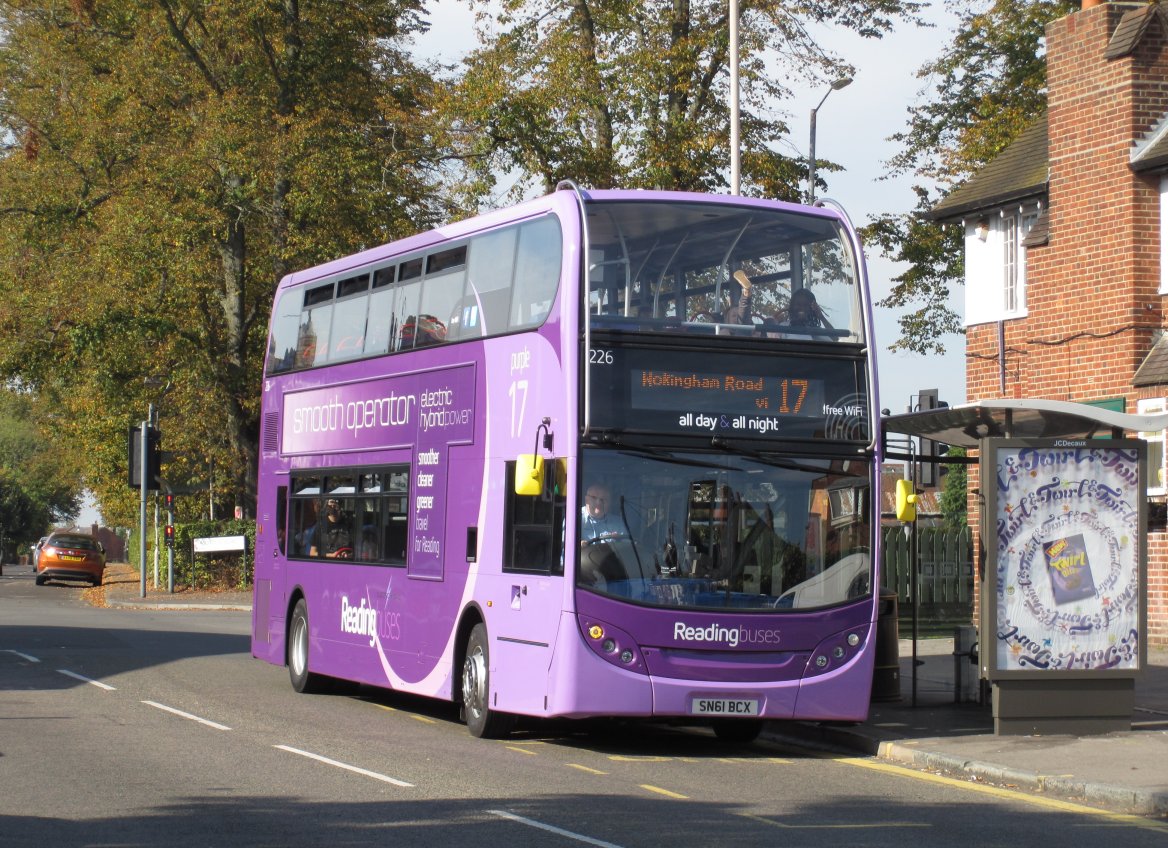
219-31 - Purple 17
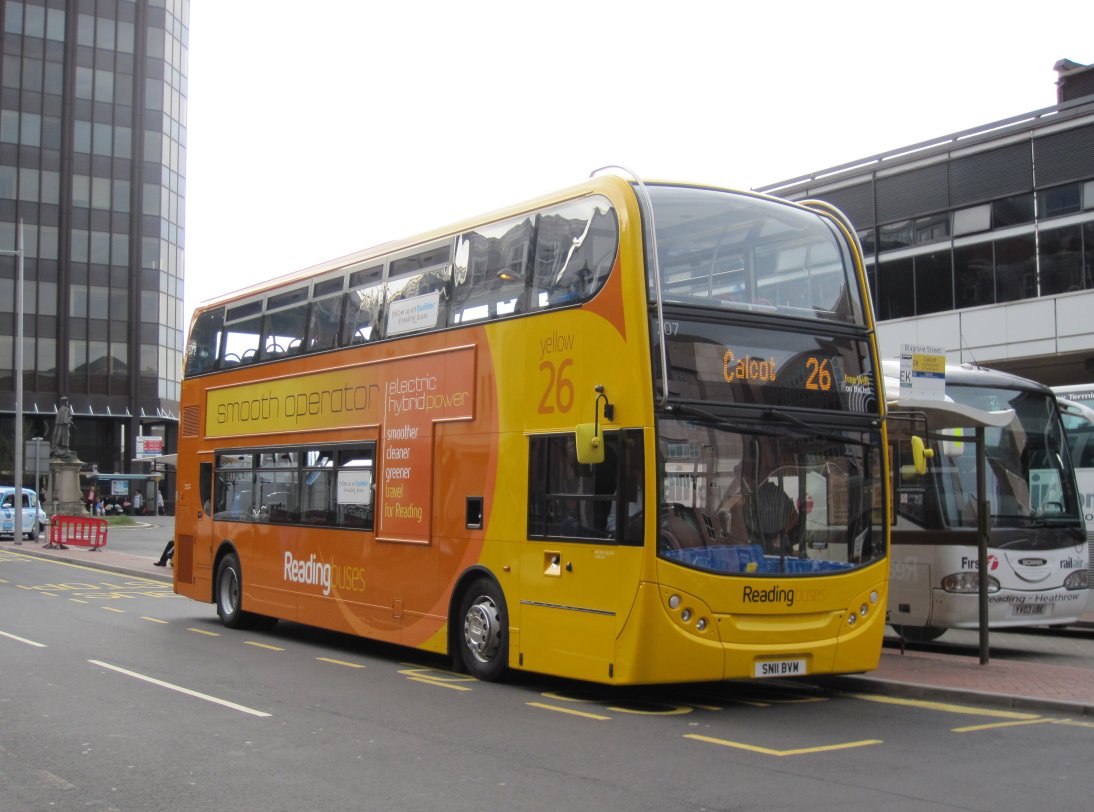
207 is seen below on its second day in service on 15th July 2011:
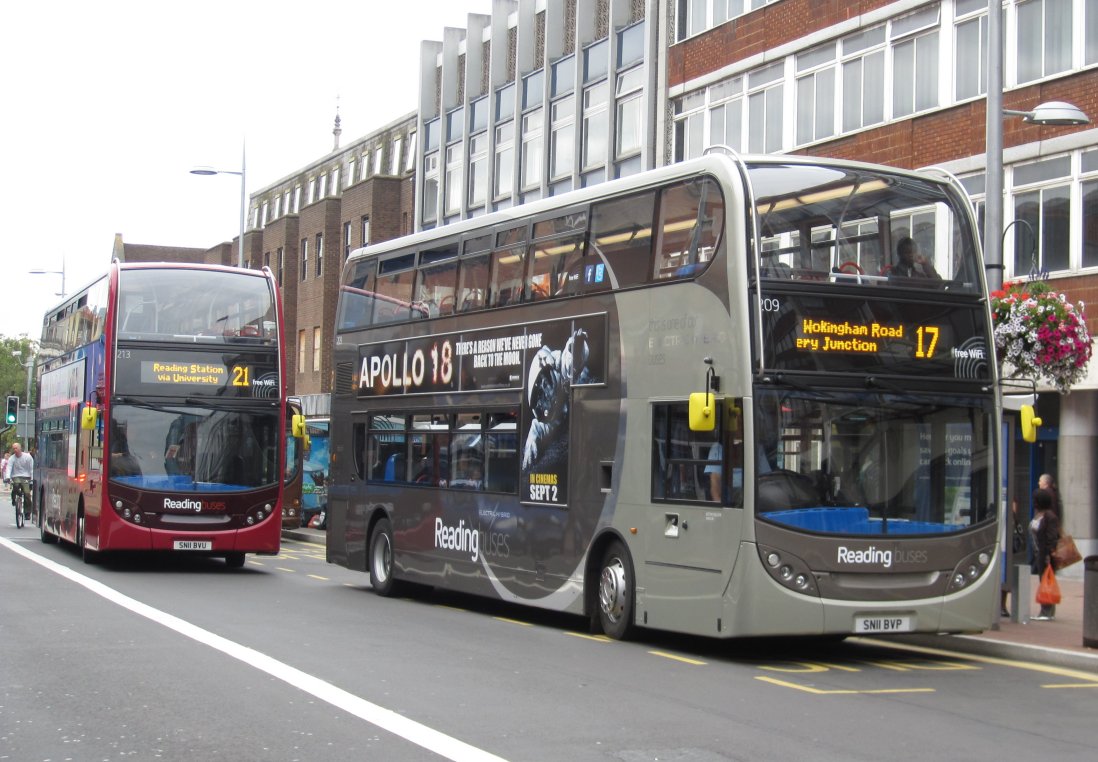
209 and 213 are seen below on Friar Street on 30th August 2011:
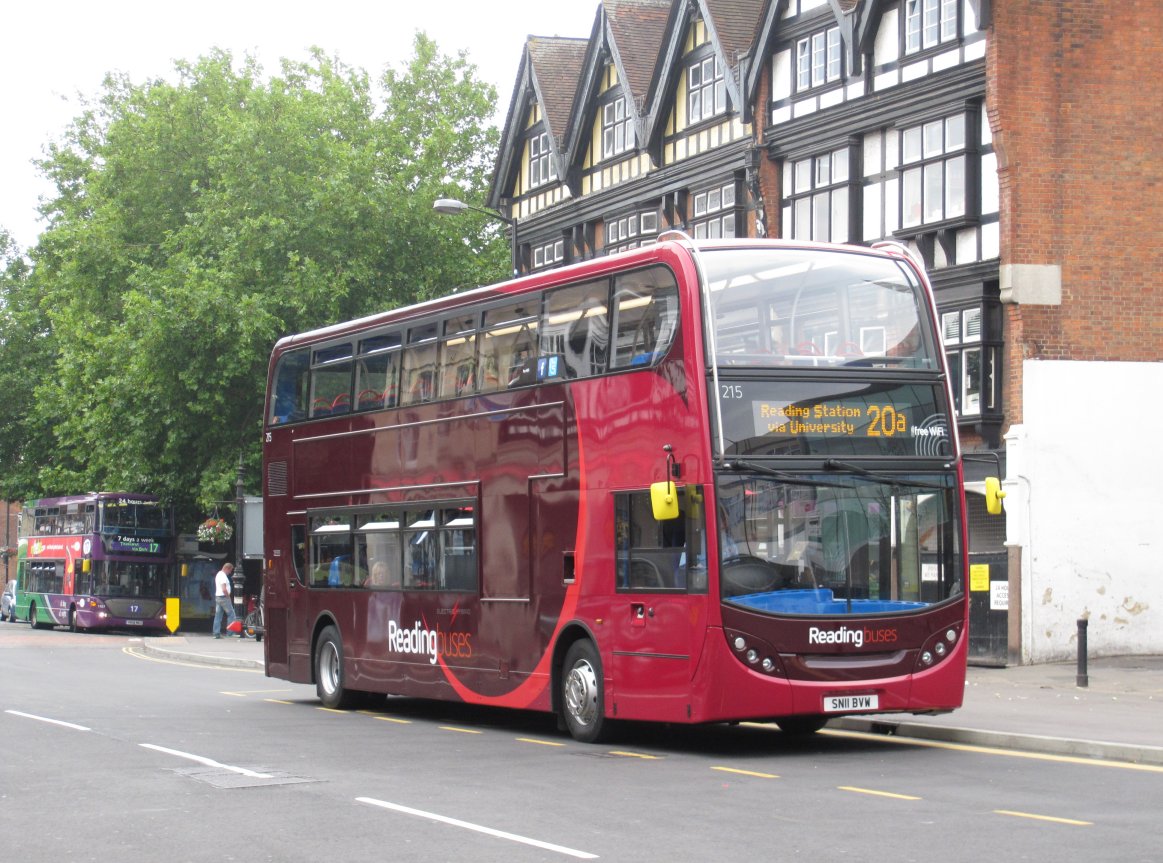
Initially, 210-18 wore unbranded Claret Routes livery to allow flexibility during the repainting of the Scania OmniCity Double Deckers on route 17 pending the delivery 219-31. Heavy rain on 16th July 2011 led to two upper deck windows being cracked, so initial arrivals 210-13/15 were taken out of service until 26th whilst the pre-planned tree pruning in Lower Earley was accelerated. 215 is seen below on it's first day in service on 15th July 2011:
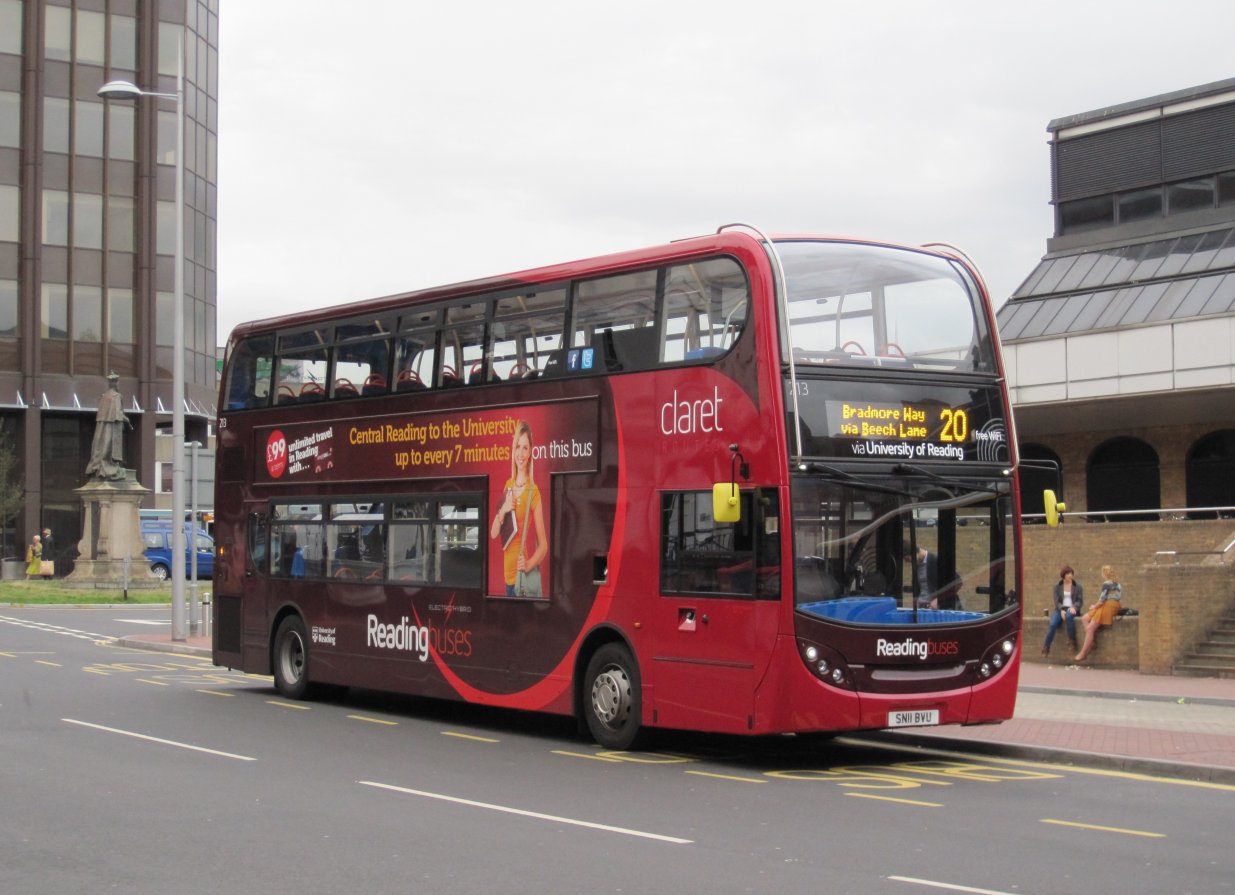
212 received full Claret Routes branding on 17/18th September 2011 ahead of the formal launch at Reading University on 19th, followed by 213 by 23rd. 213 is seen below on 26th September 2011:
220 is seen partially branded at Great Knollys Street on 5th September 2011 one day after its arrival. Thanks to Reading Buses for this photo:
226 is seen below on it's first day in service 1st October 2011:
In September 2012, 208 was repainted into Purple 17 livery to allow a daytime frequency increase from every 10 minutes to every 7-8 minutes. It was back in service by 24th September 2012, the day the timetable changes were made.
Some of the E400Hs have been named as follows:
- 202 - Marion Dollery, a significant local person recently supported by the Duchess of Kent House Hospice, the company's charity of the year at the time. Applied 3rd July 2011.
- 203 - Joan Taylor, a significant local person recently supported by the Duchess of Kent House Hospice, the company's charity of the year at the time. Applied 3rd July 2011, removed by August 2015.
- 204 - Kenneth Solly, a significant local person recently supported by the Duchess of Kent House Hospice, the company's charity of the year at the time. Applied 3rd July 2011.
- 205 - Phyllis Haydon, a significant local person recently supported by the Duchess of Kent House Hospice, the company's charity of the year at the time. Applied 3rd July 2011.
- 206 - Bob Gray, a ‘happy, proud family man’ who died in 2008 at the age of 63 having been supported by the Duchess of Kent House Hospice, the company's charity of the year at the time. Applied by 9th November 2011.
- 207 - George Strong, a customer who was supported by the Duchess of Kent House Hospice, the company's charity of the year at the time. The family of the late George Strong of Tilehurst made a donation to the hospice for the bus to be named in his memory. Applied 7th September 2012.
- 212 - Gordon Marshall, the Vice-Chancellor of Reading University who was hugely influential in the implementation of the University's carbon management programme launched in 2010. He left the University in Summer 2011. Applied 19th September 2011.
In April 2014 226 gained a white LED display on the front, being noted in service on 16th. 216 was treated the same in November 2016, first being noted in service on 25th. The white display in 216 was replaced with a standard Orange unit during the latter half of 2019.
207 (yellow), 211-8 (claret) & 219 (purple) went on loan to First Glasgow for the Commonwealth Games on 8th July 2014, completing the journey up over two days with a stop over night in Warrington. They returned the same way on 4th and 5th August 2014.
Timetable enhancements on Claret 21 from 1st and 22nd September 2014 combined with the delivery of Enviro 400s 751-8 in Claret livery enabled a number of repaints out of Claret livery:
-
210 into yellow 26 livery during August 2014, it was repainted at Bennett Trucks by 21st August, returning to service on 27th.
-
211 into generic silver, back in service by 5th December 2014
-
212 into generic silver at Hants & Dorset trim, returning on 11th November and back in service by 19th November 2014 (retaining its name Gordon Marshall)
-
213 into generic silver, returning by 7th December 2014 and re-entering service on 9th.
-
218 into purple 17 livery in September 2014
Following the acquisition of First Berkshire's route 90 from 26 July 2015, the allocation of the above was again reviewed to provide better utilisation than afforded by running term time only shorts to the University or as part of the generic fleet. Consequently, 8 out of the required 10 vehicles for the 90 (rebranded as Lion 4 / X4 from 31st August) were E400Hs 209/211-7. The vehicles were sent to Thornton's for repaint and refurbishment with wood effect floors, new black spot moquette, USB charging points and 4G WiFi added. The first to return was 216 by 31st July, which re-entered service on 1st August in base Lion livery. 217 followed by 8th August, 214 by 9th August and 215 by 15th August. 212/3 were away as at 16th August, with 212 back in service fully branded by 28th. 214 and 217 had received full Lion livery by 27th for use as part of the official 'safari' launch event, pending the service changing from 31st August. The penultimate one to be treated was 211 returning to service by 23rd September, with the last 209 held back until February 2016 pending other acquisitions for the generic fleet.
In March 2016 223 gained a full colour front destination display similar to those in 1101-14, but it was removed again by July.
The batteries in the E400Hs have a 5-year life-span and warranty, so trials were carried out during 2016 under a scheme supported by the DfT's Clean Vehicle Technology Fund as alternatives to direct replacements.
- 205 went away in approx March 2016 to Magtec for the installation of a plug-in-electric drivetrain with a 750cc on-board Compressed Natural Gas (CNG) engine to extend the range of the bus. It returned in September 2016 and spent a couple of weeks shadowing buses out of service. It went away for further enhancements to extend its range, returning on 2nd December and carrying out more tests in February 2017 before returning to service on 24th July 2017. It was fitted with updated E400 front lower dash panels and lighting whilst it was away the second time. It returned to Magtec again in January 2018 to convert it to full electric following reliability issues and insufficient range, eventually returning on 17th June 2019. It was then MoT'd and prepared for service, first being displayed at the annual open day on 30th June 2019 before re-entering service on 16 July 2019.
- A second example was to have a Vantage Power series-hybrid system fitted, bringing stop-start and selective zero emission running capability, but this was not completed.
- 223 went away to Scarborough and District in January 2017 to be converted to standard diesel operation using the existing engine, replacing the batteries with a gearbox. It returned to service in May with most of it's electric hybrid branding removed.
Following the successful trial with 223, conversions started on the remaining route 17 hybrids upon failure, pending cascade onto other routes at the end of 2017. 218 lost its branding for route 17 in February 2018, operating in base purple livery pending repaint. 222, 224 and 226 were treated similarly by the start of April.
- 220 was converted to diesel in June 2017, losing its electric hybrid branding in July
- 219 which was noted in Morpeth on 23rd June 2017 and was due back on 28th July and noted back in service on 3rd August with its electric hybrid branding removed. It was then repainted from base Berry livery to generic silver orbits livery during October 2018, being surplus to requirements on the Berry route following timetable changes. It remains unrefubished.
- 225 returned to service on 28th October 2017, and was the first to be fully refurbished and repainted into an updated Sky Blue livery for routes 15 and 16.
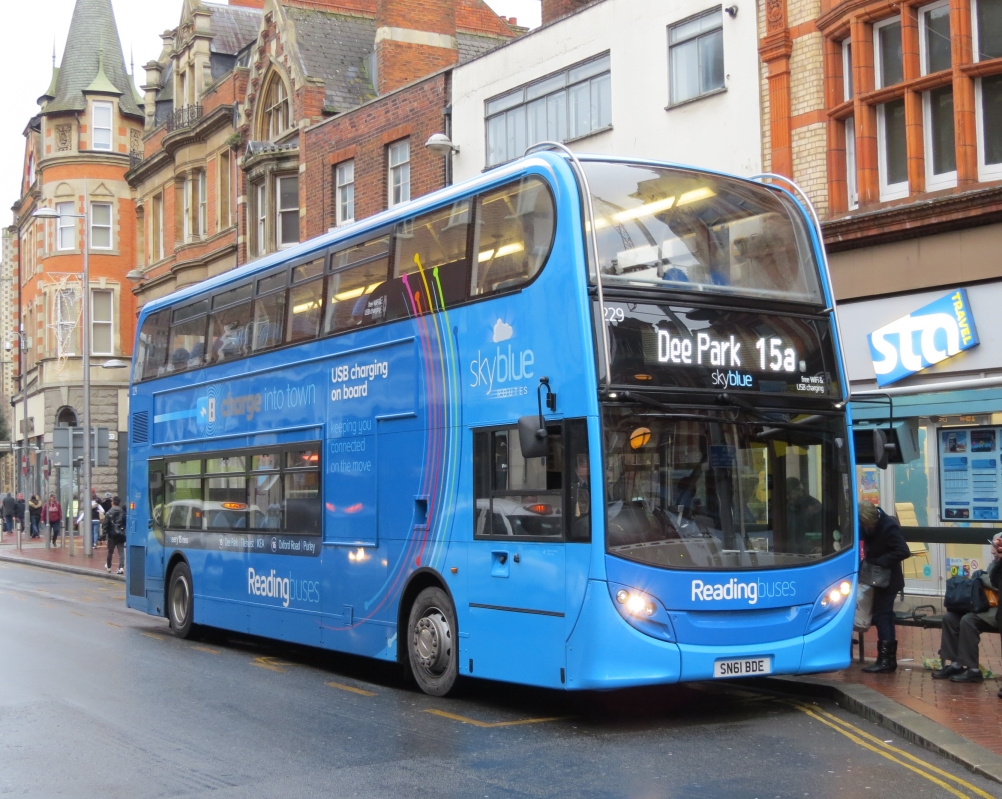
- 229 returned in November 2017, refurbished and in Sky Blue livery, re-entering service on 6th November
- 208 had been converted to diesel by 29th November 2017 and en-route for refurbishment. It returned on 17th January 2018 refurbished and in base Sky Blue livery, had vinyls applied on 19th and returned to service on 20th.
- 221 and 228 were away during December 2017, 221 returning in Berries livery by 14th March and returning to service on 20th, and 228 returning to service in Sky Blue livery on 30th March.
- 220 was repainted into Berries livery in February 2018, returning by 15th and returning to service on 17th.
- 230 was away in March, and attended the Association of Local Bus Company Managers conference in Scotland on 1st May prior to returning to Reading by 4th May and re-entering service on 5th. It went away for refurbishment during October 2018, having previously only been repainted, returning on 31st.
- 231 went away on 2nd March, returning to service on 25th May.
- 223 was refurbished repainted into Berries livery in May 2018 following its earlier diesel conversion, returning to service on 5th June.
- 227 returned to service on 21st June in Sky Blue livery.
- 222 returned from conversion to diesel power, refurbishment and repaint into base Berry livery in early July 2018.
- 226 returned to service after conversion from hybrid to diesel power, refurbishment and repaint into Sky Blue livery in mid August 2018.
- 224 returned to service after conversion from hybrid to diesel power, refurbishment and repaint into Sky Blue livery in September 2018.
- 218 returned to service after conversion from hybrid to diesel power, refurbishment and repaint into Sky Blue livery on 2nd October 2018, completing the program of repower and refurbishment works.
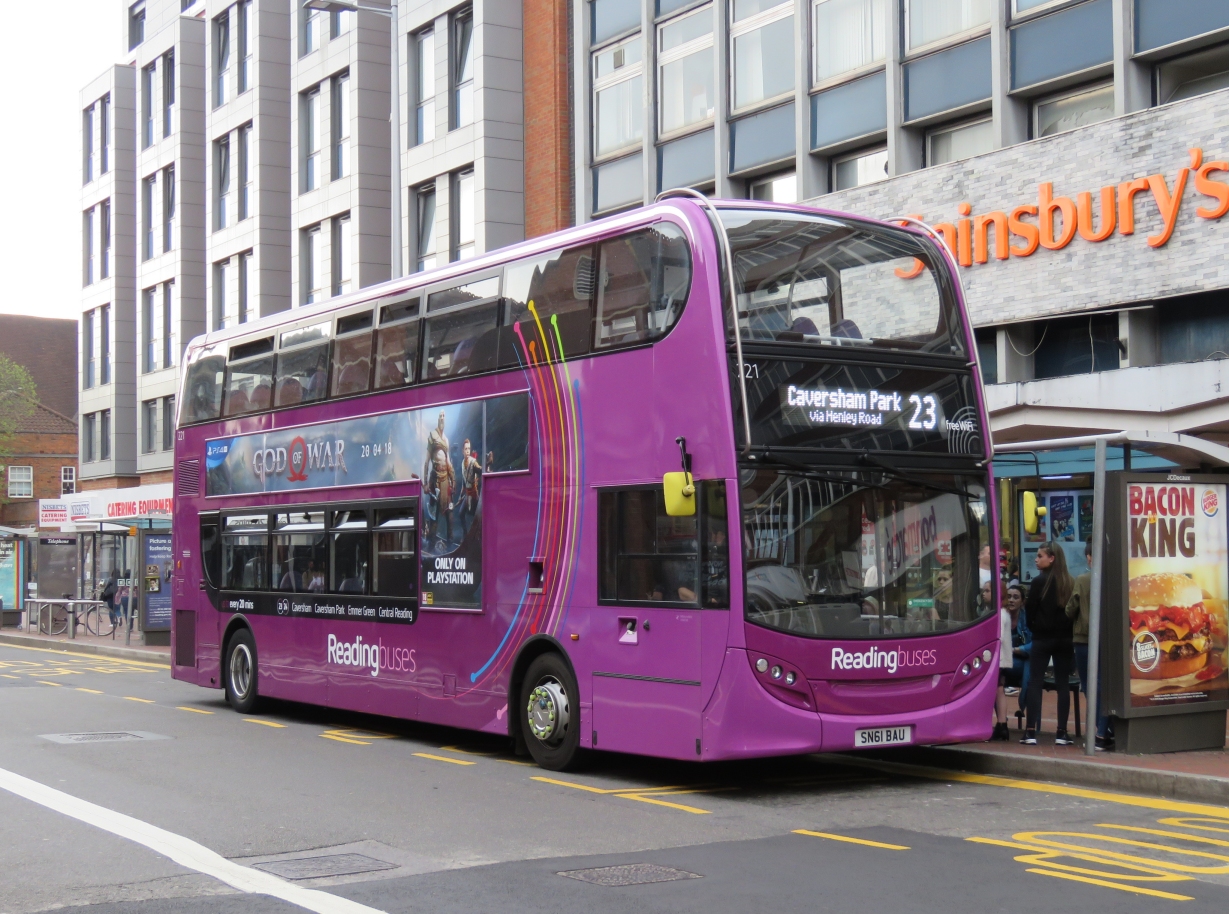
220-23 received the Berry brand name on base livery in late August 2018 ready for the new timetables starting on 3 September. 221 is seen below on 21 April 2018 without the branding applied:
229 is seen below on 2 December 2017:
220 went on loan to Newbury on 15th January 2018 until 30th January, being replaced by 223 from 31st January until 9th February to cover 1208 transferring to Greenline work pending changes to the Vodafone network. 231 then went on loan to Newbury on 16th February, returning on 2nd March. 223 went on loan to Newbury again on 13th March until 25th April.
203 was written off following an engine fire at Calcot Sainsbury's on 14th May 2017 and taken away in late June. 215 suffered a similar fate in Wokingham on 29th November 2018 and was taken away on 30 January 2020.
The older Yellow and Lion hybrids had their warranties renewed for a second 5-year span. When the time came to consider future options in 2020 a third 5-year warranty was not an option, so a programme of conversions was undertaken along with an update to the livery and refurbishment of the yellows:
- 201 went away for conversion to diesel at Loansdean, Scarborough on 22 June 2020, moving to Bus & Coach World Blackburn on 12 August for repaint into generic silver orbits
- 204 went away for refurbishment and repaint into base Yellow orbits livery at Bus & Coach World Blackburn on 23 June 2020, moving to Loansdean, Scarborough for conversion to diesel.
208 went away to Hants & Dorset trim on 30 June for repaint into base Yellow 26 orbits livery, and the replacement it's sky blue head rests with grey ones.

Two examples were acquired with Courtney Buses on 30th April 2019, and allocated numbers 234/5. They were new for the Milton Park contract in a light blue livery, but subsequently cascaded onto other contract work. They were converted to diesel during 2019, the process having started prior to acquisition in April, and completed afterwards.
Following swiftly on from the announcement of the Green Bus Fund funding, an E400H demonstrator SN59 AWW was borrowed between 2nd and 4th November 2009, appearing in service on route 17 on 3rd and 4th. It was hailed by drivers and customers alike as an outstanding vehicle. A dozen prototype ADL 400 Enviro hybrids had also been running very reliably in London on routes 16 and 24 for the past 18 months which were also reported to be excellent.
At the heart of this hybrid is a system developed by BAe Systems, Rochester which has been widely used in America over the last ten years, coupled with familiar Alexander Dennis parts. A battery powered electric motor provides the traction with a small diesel engine (in the case of the demonstrator the same as fitted to ADL Enviro 200 Darts) charging modern lithium-ion batteries. Power is also derived from regenerative braking where energy that would normally be converted to heat or sound is diverted back to the batteries, meaning that overall the Enviro 400H is guaranteed to be at least 20% more fuel efficient than a normal diesel powered vehicle. The cost of the batteries and specialist systems mean that the vehicles are considerably more expensive to buy, but the manufactures expect that the fuel savings will pay for a significant amount of this when factored across the whole life of the vehicle. In addition, as the vehicle does not use a gearbox it has a significantly smoother ride.
The demonstrator, given temporary fleet number 900 is seen below on 3rd November 2009:
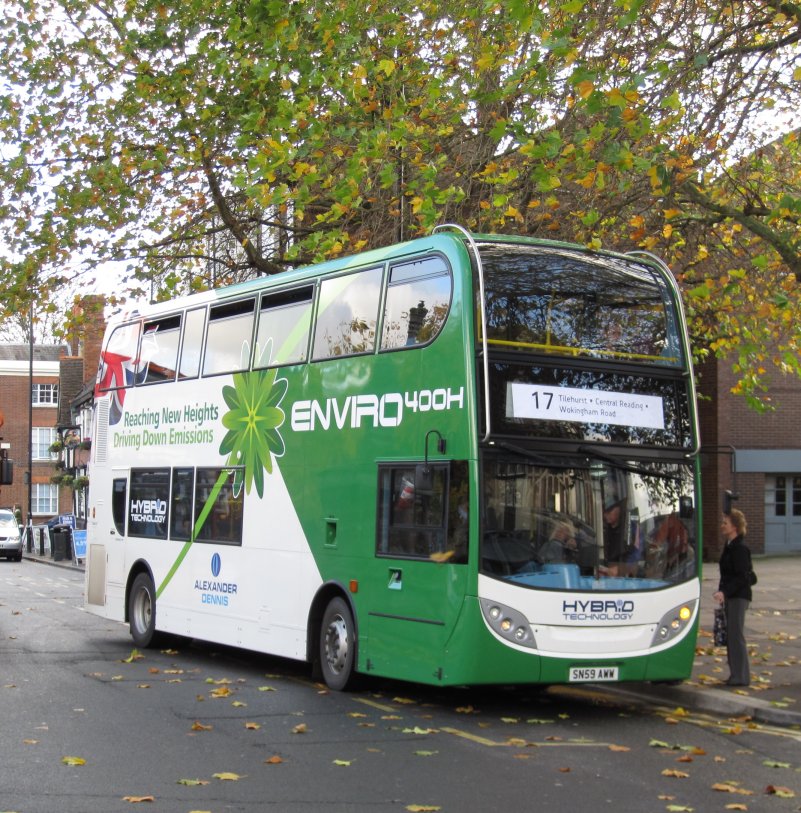
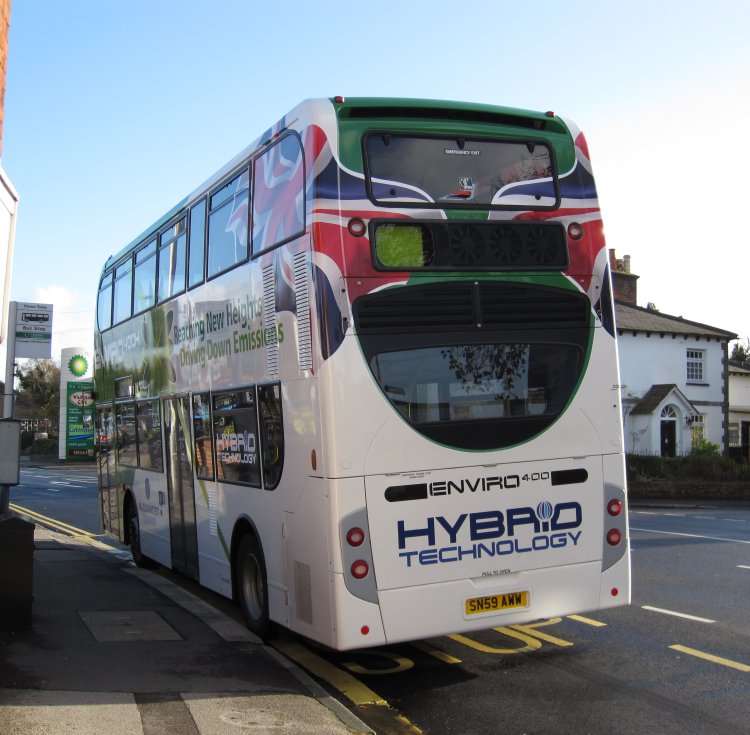
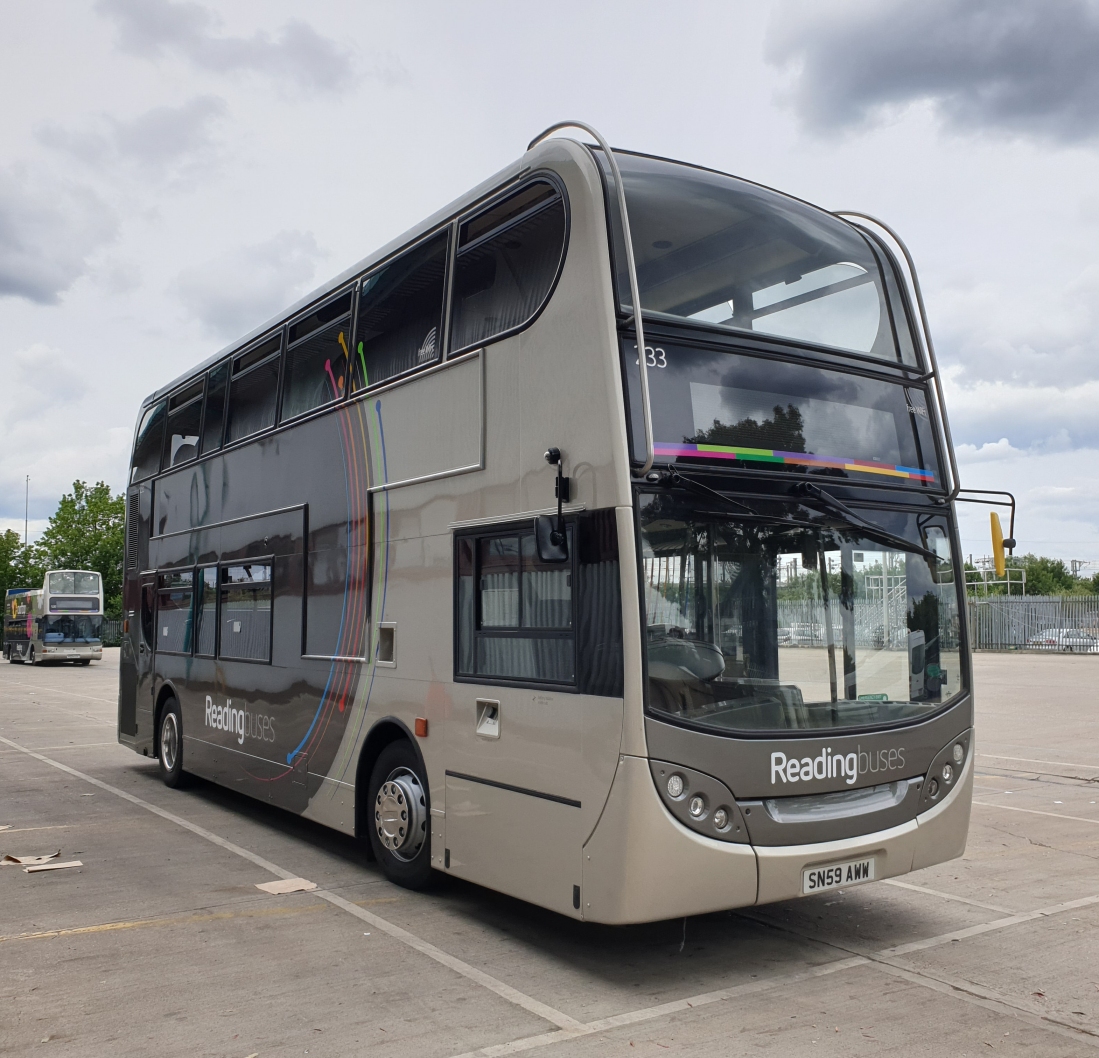
The demonstrator returned briefly on 15th April 2010 to coincide with the press release regarding the order of the first vehicles, and was subsequently purchased in March 2019 to replace fire damaged 215. It had been converted to diesel in a similar way to Reading examples prior to purchase, and was sent away for centre door removal, repaint into generic silver orbits livery and full interior refurbishment prior to delivery to Reading in late May where it became 233. It entered service on 10th July following fitment of CCTV, ticket machine and cash vault. It is seen below before that on 5 June 2019:
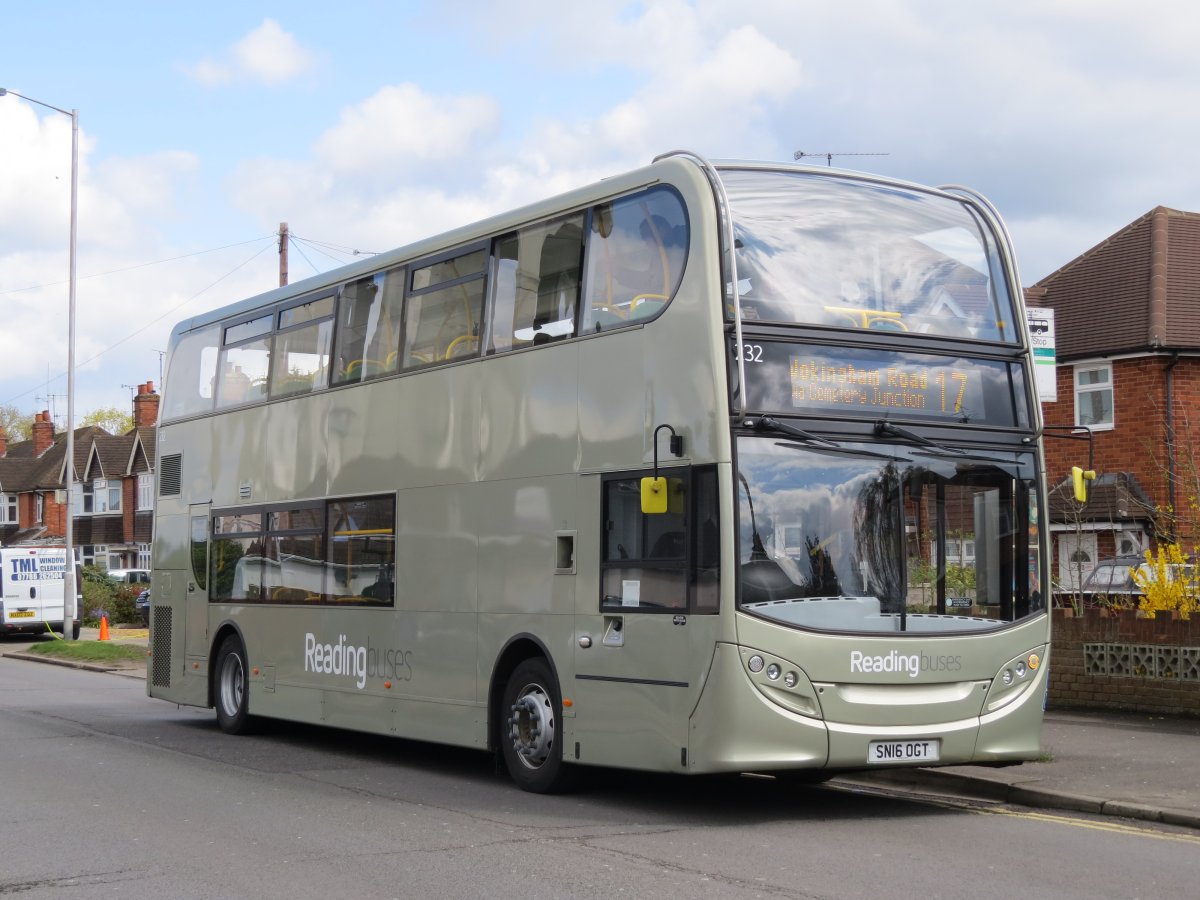
Demonstrator SN16 OGT arrived on 19th March 2016 to cover for warranty work on 751-74 having been a development vehicle at the factory in Falkirk. It was given fleet number 232 and entered service on 8th April 2016. It is seen below on 23 April 2016:
232 left the fleet after use on 26th February 2019 on completion of the first phase of warranty work on 751-774, and immediately went to First Glasgow. It was expected back in 2020 to cover further work but did not materialise.
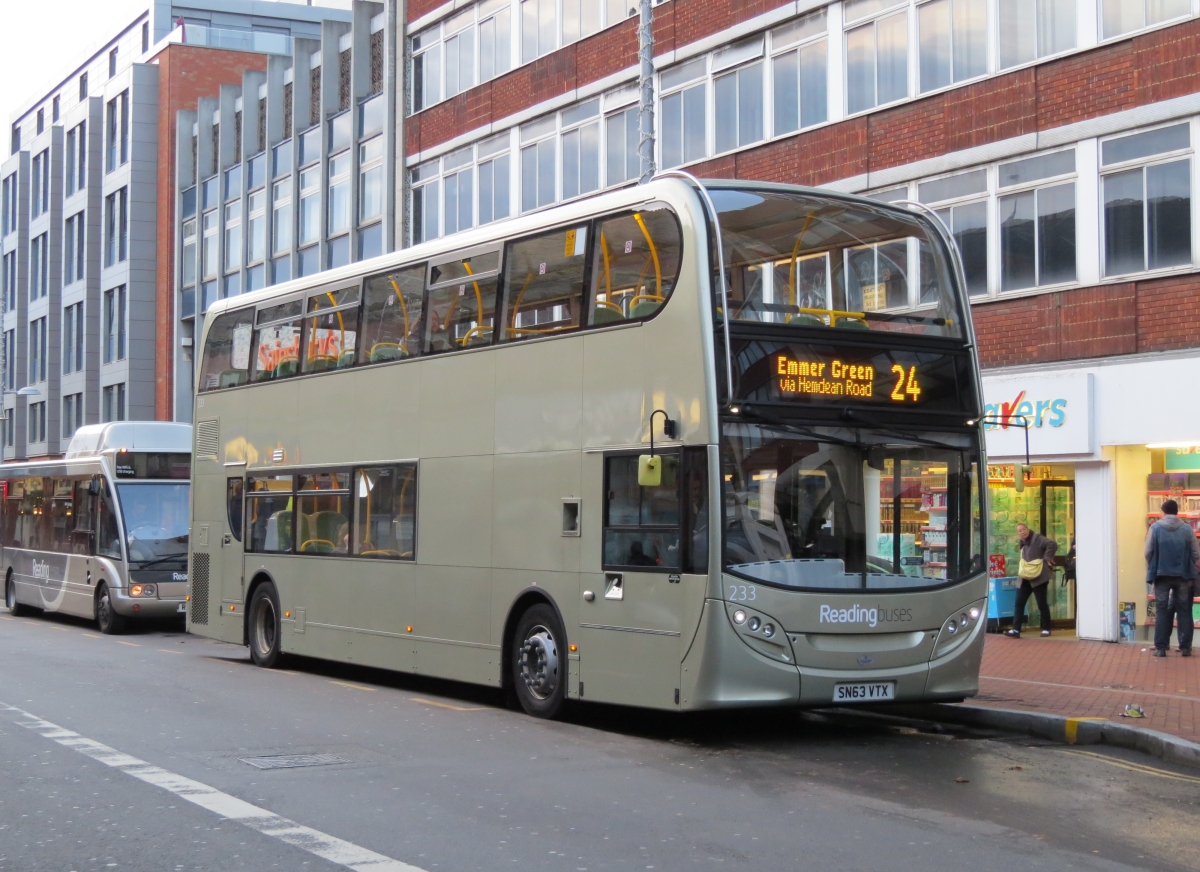
A further demonstrator SN63 VTX arrived on approx 21 October 2016 on extended loan. It was given fleet number 233 and was last seen in service on 19th January 2017, moving to Cardiff Bus on 23rd where it was in service on 24th. It is seen below on 9 November 2016: